
Reliable Air Conditioning Service in Folsom When You Need It Most
Most homeowners think an air conditioner works without issue until it stops. The reality, under the intense Folsom sun, is a gradual decline. Your system fights harder each summer, components wear thin, and performance drops off a cliff. Before you know it, the air feels humid, you notice a strange sour smell from the vents, and your system is on a path to a complete breakdown on the hottest day of the year.
At that point, a dependable air conditioning service becomes crucial. We provide precise and honest ac repair in folsom ca, focused on diagnosing the core issue instead of patching symptoms. With a focus on mechanical fact, our work aims to restore your system's performance for the long term. Getting your cooling service in Folsom right means you can depend on your AC when you need it most.
7 Clear Signs You Need Professional AC Repair
Last summer, I saw a system where the homeowner noticed weak airflow for weeks, a small visual sign that hinted at a much larger, more expensive compressor failure. It's a common story in Folsom, a minor symptom gets ignored until the whole air conditioning system goes down during a heatwave. Another major red flag's any visible frost or ice buildup on the copper refrigerant lines or the indoor evaporator coil, a clear signal of low refrigerant. That layer of solid ice should never form. Short-cycling is another warning sign. Your system powers on and off in rapid, ineffective bursts. Instead of running for a full 15 to 20 minutes, it might shut down after just five. This behavior puts immense strain on the compressor and fan motors.
Look for water. A visible puddle forming around your indoor air handler points to a clogged condensate drain line, a big issue with our area's hard water buildup. Ignoring this can lead to significant water damage and mold growth.
Circuit breaker trips aren't normal. Your breaker's a safety device, and a system that keeps tripping it's telling you it's drawing too much power. By ignoring this, you risk serious electrical damage to the unit or your home. This is due to a failing capacitor or a struggling compressor motor. In Folsom's intense heat, capacitors have a much higher failure rate once outside temperatures stay above 95 degrees for extended periods. A dimming of your home's lights when the AC kicks on is another electrical distress signal. It shows the system is pulling a massive current on startup. That initial power draw should be smooth, not disruptive.
Your energy bills also provide vital clues. A sudden, unexplained spike in your SMUD bill means your unit's working much harder to produce the same amount of cool air. This indicates a loss of efficiency somewhere in the system. Perhaps the outdoor condenser coil is caked with dirt, which you can see. Perhaps the refrigerant charge is wrong. Checking your utility costs is a simple, effective diagnostic tool you can use from your chair. An inefficient system is a failing system.
Seeing any of these signs means it's time for a professional diagnosis before a small issue becomes a total system replacement.
24/7 Emergency Home Services for HVAC Breakdowns
Last summer, I took a call where the indoor temperature was already climbing past ninety degrees inside the house. That heat becomes a real danger zone. This is when an AC failure stops being an inconvenience.
An HVAC emergency isn't a minor drip or a strange noise. It's a total loss of cooling during extreme weather. When Folsom heatwaves spike to a blistering 108°F, the situation inside a home can become unsafe within hours. The suffocating, stagnant air puts immense strain on the elderly, young children, and pets. Thinking about the potential health risks is what defines The emergency response. Without moving air, the oppressive feeling of heat builds fast. For certain households, this requires an immediate fix, not a next-day appointment.
By offering round-the-clock emergency home services, we provide a critical safety net against that kind of heat. Our commitment's a response time under 60 minutes inside Folsom city limits. Our trucks arrive stocked with the components that fail most under stress: capacitors, fan motors, and contactors. We don't waste time on a return trip for a common part. The first priority upon arrival is to make the system safe and then perform a fast, accurate diagnosis. The goal is to restore cooling, not conduct a full system overhaul at midnight. We get the air moving again.
During these intense heat events, we see predictable patterns of failure. Compressor failures see a sharp increase, jumping by 40% when temperatures stay over one hundred degrees for several days straight. Capacitors (the small cylindrical parts that give motors a startup jolt) are another major failure point. They degrade with each heat cycle. A fan motor that seizes from overheating or a contactor with welded points are other frequent finds. These components are the system's front-line soldiers. Under constant thermal assault, they're the first to fall.
Our folsom emergency service focuses on a clear objective: triage and stabilization. We're there to fix the immediate problem that caused the total system shutdown. This might mean replacing a failed capacitor to get the fan spinning. It might involve bypassing a faulty sensor to restore basic function. A more detailed system health check can wait for a scheduled follow-up during normal business hours.
When your AC quits on the hottest night of the year, you need action. You need a solution right now.
Prevent Future Issues with Routine HVAC Maintenance
But why do these emergency failures happen in the first place? Most catastrophic breakdowns I see share a single origin point, neglect.
Routine HVAC maintenance's the single best defense against surprise failures. This isn't just about changing a filter. With our tune-ups, we perform a deep clean of the outdoor condenser coils. Clogged coils choke the system, forcing the compressor to work much harder to release heat. That strain is what leads to burnout on the hottest days of the year.
Beyond cleaning, we check all high-voltage connections for tightness and signs of arcing. We measure the amperage draw of the fan motor and the compressor. A motor pulling too many amps is a motor on its way out. Checking these components allows us to hear subtle changes in operation. That high-pitched whine or a slight metallic rattle is a clear signal of distress. It tells us a bearing is failing or a fan blade is off-balance. Finding these issues during a planned visit is far better than a midnight call. We can fix it with a small part before it destroys a major component.
This proactive approach saves you serious money. You avoid the cost of an emergency service call and the price of a more expensive repair.
System maintenance does more than prevent breakdowns. It protects your investment. A clean and calibrated air conditioner runs with far less effort. It uses less electricity, which you'll see on your monthly bills. Keeping the system in prime condition also extends its operational lifespan by years. You get more out of the equipment you already own. And your home stays cool and comfortable without interruption. No one wants to face a Folsom heatwave with a dead AC unit.
Think of it like an oil change for your car. You do it to keep reliability. Proper care's the foundation of a dependable home comfort system.
Repair vs. Replacement: Making the Right Choice for Your Home
A homeowner last summer faced this precise, difficult choice. His old air conditioner needed an expensive compressor fix. Knowing when to invest in a repair versus a full system replacement requires a hard look at the numbers and the machine's age.
A straightforward repair makes absolute sense on newer systems. If the repair cost's less than half the price of a new installation, fixing it's the practical move. We call this our 50% rule of thumb. It avoids a large capital expense for a component failure (like a capacitor or fan motor) that isn't catastrophic. These fixes are manageable expenses. But a patched-up older system might still struggle. You feel that lack of deep cold on a sweltering afternoon. The air just doesn't have that crisp edge. That weak, cool-but-not-cold airflow is a clear warning sign of deeper problems.
With systems over 10 years old, however, the math changes completely. These older units frequently use R-22 refrigerant. Since the federal phase-out in 2020, this coolant's both expensive and scarce. A major leak fix becomes a massive investment in an obsolete machine. By choosing a replacement, you get a new warranty and superior energy performance. The long-term savings are significant. Seeing the immediate drop in your utility bill is the best confirmation. And your home will feel colder, faster, without putting strain on old, worn equipment.
Professional AC Installation Services in Folsom
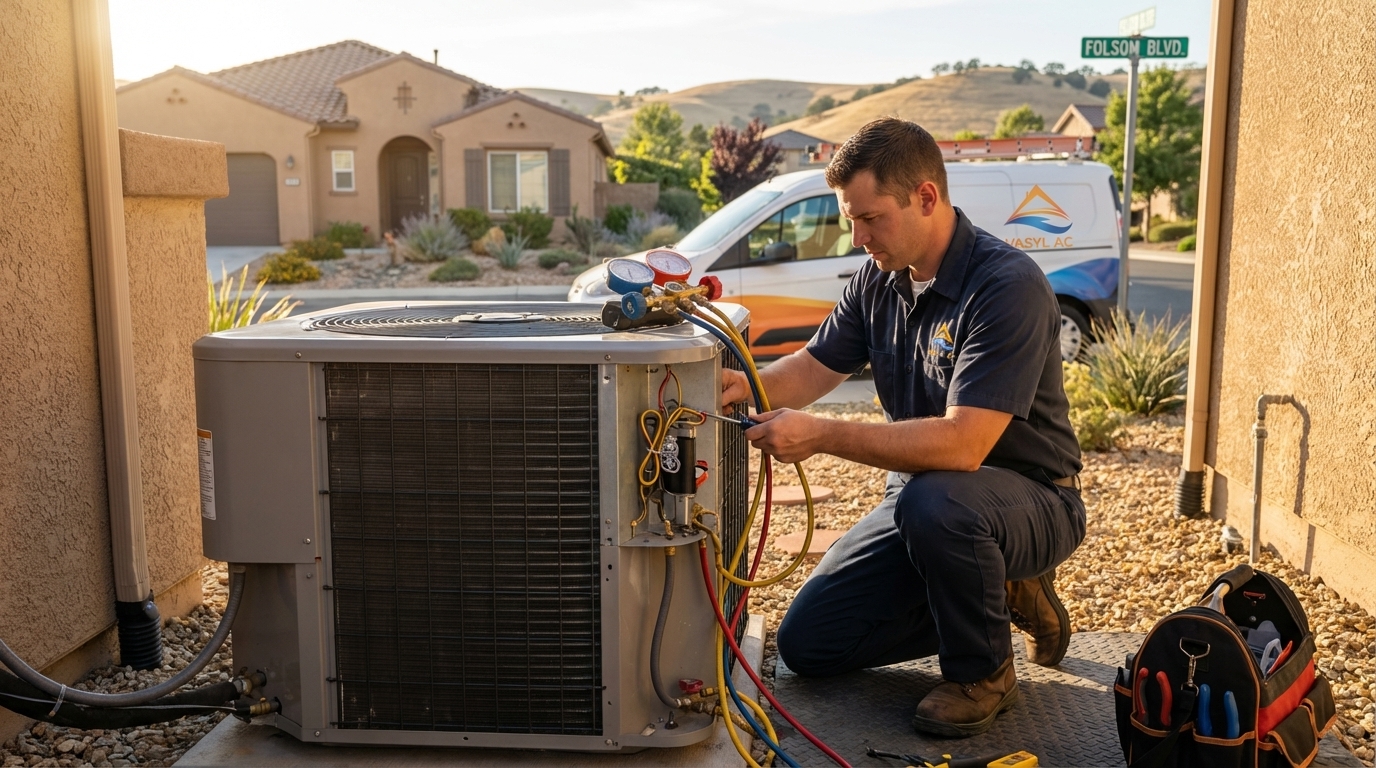
When replacement's the clear choice, the installation itself determines the system's performance for the next fifteen years. The entire process starts with a meticulous load calculation to find the perfect size for your home's unique needs. This crucial first step avoids all the common sizing mistakes. By factoring in your home's layout, window efficiency, insulation levels, and direct sun exposure, we find the exact tonnage required for genuine comfort. An oversized system will cycle on and off too fast to remove humidity, which creates a noticeable musty smell coming from perpetually damp coils. That clammy, uncomfortable air is the classic result. Conversely, an undersized unit runs nonstop on hot Folsom days. Both errors guarantee high bills and a shortened equipment lifespan.
Choosing the right efficiency rating, or SEER, is the next decision. A higher number means more cooling per watt consumed. Modern units must meet a federal minimum, but a higher-rated system offers considerable savings. But that rating's only valid if the system is a matched set. The outdoor condenser and indoor air handler must be factory-designed partners. Mismatched components negate the promised performance and can shorten the unit’s life.
On installation day, our first task's the safe removal of your old equipment. We set the new condenser on a level pad, connecting the electrical and refrigerant lines with care. A deep vacuum is pulled on the copper line set, removing all moisture before refrigerant is introduced. This step, rushed by others, is vital for the new compressor's health.
With clean lines, we charge the system with the manufacturer's specified weight of refrigerant. This is a precise measurement. We confirm operation by taking detailed superheat and subcooling readings. These diagnostics prove the unit performs at peak efficiency from startup. Then we test the thermostat and balance the airflow. After a full cleanup, we explain the new system, its warranty, and maintenance needs. Your home is left cool and comfortable.
Don't Forget the Heat: Furnace Repair & Replacement
Last year a Folsom client last year who celebrated their new AC in August, only to call us in a panic that November. A sudden cold snap revealed their furnace was completely dead, a problem ignored all summer while the air conditioner ran nonstop. That experience underscores a local truth. True year-round comfort requires a reliable heating system ready for our chilly, damp winters.
Most furnace failures begin with the ignition sequence. Modern units use a hot surface ignitor, a fragile component that cracks over time and prevents the burners from lighting. Older systems might have a pilot light issue, from a dirty thermocouple that fails to sense the flame. Another common fault's a failing blower motor capacitor. Your furnace might ignite but never push warm air through the vents. With a simple diagnostic, we can pinpoint the precise component failure. Checking the system's limit switches and flame sensor is also part of our initial inspection. A dirty flame sensor, for instance, can shut a furnace down on a safety trip, even when nothing dangerous is wrong.
For systems under ten years old, a targeted furnace repair's almost always the smart financial choice. Replacing a faulty ignitor or capacitor is a straightforward job that restores full function without a major expense. But a furnace with a cracked heat exchanger presents a serious carbon monoxide risk and demands immediate Folsom furnace replacement. Beyond that immediate danger, an aging unit with a low AFUE rating wastes fuel, making an upgrade a sound investment in both safety and lower utility bills.
Why Folsom Residents Trust The HVAC Contractors
But why trust one company over another when so many make the same promises about quality, leaving homeowners to sort through a sea of marketing claims?
It starts with verifiable credentials, not vague assurances written on a van. All our technicians are NATE-certified, the gold standard of training and competence in the HVAC field. With an active CSLB License #987654, we operate with total transparency under state oversight. This isn't a hobby for us. Knowing the subtle differences between textbook problems and the complex failures seen in Folsom homes takes years of hands-on work. My team brings decades of combined field experience. We've seen almost every brand and system age. We can distinguish the bitter, metallic taste of ozone from a failing contactor versus the smell of burnt wiring. That diagnostic sense (something you can’t learn from a manual) prevents guessing games and protects your wallet.
Our confidence in our work's a structural part of our guarantee to your family. The team offers a full 10-year parts warranty on new system installations, giving you concrete protection for an entire decade.
Beyond that, it comes down to accountability as your neighbor. We live and work in this community too. Our reputation in Folsom isn't an abstract concept. It’s built one successful service call at a time with your friends. If a repair we perform doesn't hold, you know where to find us. We won’t hide behind an anonymous call center or a vague email address. But a promise made face-to-face in your living room means more to us than any slick advertisement could. We stand behind our work, without excuses.
Serving Folsom and the Greater Sacramento Area
The service trucks are a constant and common sight across Folsom, from the established neighborhoods of Empire Ranch to the newer homes in Briggs Ranch. These primary field focus, however, is a defined and strategic operational zone. This deliberate boundary isn't about exclusion. It's a quality control measure that maintains we can guarantee a rapid and effective response time for every single customer. That's our unbreakable promise, during brutal summer heatwaves when urgent calls spike all along the busy Highway 50 corridor from Rancho Cordova clear to El Dorado Hills. We structure our entire dispatch system around keeping all travel times predictable and as short as possible. This intense local concentration's our foundational commitment to speed and genuine technical reliability for you. By keeping our most experienced technical team based here, we extend complete HVAC repair service to several adjacent communities without sacrificing an ounce of quality. We'll never compromise our core commitment to Folsom homeowners who need a trusted technician on-site right away.
Sending one of our best technicians on a ninety-minute cross-county drive through unpredictable traffic for a simple diagnostic introduces unacceptable delays and uncertainty, which's something we flat-out refuse to build into our professional service model.
Within this defined area, you'll see our well-stocked vans navigating from the historic district to the growing developments near Iron Point Road and the Palladio. Knowing the local backroads and specific rush-hour traffic patterns is a genuine, practical advantage our seasoned team applies every day. This intimate knowledge lets our dispatched technicians bypass unexpected afternoon gridlock on Folsom Boulevard or choose Prairie City Road when a predictable accident clogs the freeway. It translates direct into a technician arriving at your front door much sooner, with all the right diagnostic equipment ready to go. While we field calls from farther out in the region, our firm commitment remains to the communities we can serve with absolute precision and speed. For all the homeowners living inside this dedicated service zone, that means a faster, more dependable restoration of your home comfort. That's our main goal and a promise we take with immense seriousness.
More Than Just AC: Comprehensive Home Services
HVAC's The core. But our deep roots in Folsom mean we see the whole home, from the air ducts tied to your furnace to the plumbing lines running alongside them. This comprehensive perspective allows our technicians to identify and diagnose interconnected problems that a single-focus specialist could overlook. A complete home health perspective matters.
Beyond heating and cooling, our expertise extends into your home’s plumbing infrastructure. A slow drain, for instance, can create excess humidity, forcing your AC to work with much more effort. That faint sewer gas smell might not be a venting issue but an unseen drain problem impacting air quality. Seeing how these systems interact's the key to a real solution. It’s more than fixing a single symptom. By addressing the source, we protect your primary HVAC equipment from undue stress and corrosion.
Indoor air quality's another specialty we manage with precision. The team handles duct cleaning and advanced air filtration. These services are essential for health. Poor drainage can release airborne contaminants. Our goal is clear: make certain the air your family breathes is clean. This integrated service saves you from coordinating multiple contractors. You make one call. We diagnose the entire chain of events. From the furnace to the faucet, we see how every component works together.
Our Proven Repair Process: What to Expect
The repair journey begins with your initial phone call, where we gather crucial details to understand the system's behavior before we even arrive. Upon arrival, our technician performs a complete system diagnostic, checking refrigerant pressures, electrical connections, and airflow to pinpoint the failure. We find the real problem. We don’t treat symptoms. After the inspection, you receive a detailed explanation of the issue alongside a firm, written quote for the required repair. No work ever begins without your full authorization (a commitment to no surprises).
With your approval, we proceed using the correct parts for your specific model. We don't believe in temporary patches or mismatched components. Following the component replacement or adjustment, we conduct a full operational test. This commissioning phase verifies pressures are stable and temperatures are correct. The goal's restoring performance, not just stopping a noise. We make sure the stale, dusty taste of poor airflow is eliminated before we consider the job done.
Frequently Asked Questions About Folsom HVAC Repair
But even with a clear repair process, most people have practical questions. Understanding the potential costs, average timelines, and what a technician inspects provides peace of mind when the AC quits in August. Here are direct answers to the most common concerns.
How much does an AC repair cost in Folsom?
The final cost depends entirely on the failed component. A capacitor replacement, a frequent issue in the heat, might be a few hundred dollars. In contrast, diagnosing a refrigerant leak's a more involved process with a higher price. A failed blower motor represents a significant repair, costing more than expected. A compressor failure is the most expensive repair before a total replacement. After our diagnostic, we provide a firm, upfront quote. You approve all work before we begin.
How long will my air conditioning repair take?
Most common repairs, like replacing a fan motor or cleaning a clogged drain line, are completed in under two hours from our arrival.
Should I repair my old AC unit or replace it?
This is a critical decision. We use the 5,000 rule: multiply the unit's age by the repair cost. If that number exceeds $5,000, replacement offers better long-term value. With older systems using phased-out R-22 refrigerant, repairs are expensive. An AC unit over 12 years old is operating on borrowed time. Upgrading to a modern, high-SEER system provides immediate utility savings. A new system includes a full 10-year parts warranty. It's an investment in your home's comfort.
What are those strange smells coming from my vents?
By paying attention to smells, you can get ahead of major problems. A musty or dirty-sock odor points to organic growth on the indoor evaporator coil. This situation requires a specific deep cleaning service to resolve. If you detect a sharp, acrid smell similar to gunpowder, it could mean a motor's overheating. Shut the system down at once. That smell indicates a serious electrical fault. A burning plastic scent can point to compromised wiring or a failing control board. Never ignore these important olfactory warning signs.
Is annual HVAC maintenance really necessary?
Yes, preventative maintenance's essential for system health and peak performance. Skipping a tune-up is like missing oil changes on your car. The damage accumulates over time. During a service visit, a technician cleans coils, tests safety controls, and tightens all electrical connections. These small adjustments prevent catastrophic failures on the hottest days. This regular work also keeps your energy consumption down and your bills lower.
Why Choose Vasyl AC?
✓ Licensed and insured HVAC contractor
✓ 24/7 emergency service available
✓ Free estimates on installations
✓ Experienced, certified technicians
✓ Competitive pricing and honest quotes
✓ Satisfaction guarantee on all work
Vasyl AC
Professional HVAC services you can trust. We provide expert air conditioning repair, installation, and maintenance services for residential and commercial properties.
© 2026 Vasyl AC. All rights reserved. | Licensed & Insured HVAC Contractor