
Keep Cool All Summer with Expert AC Maintenance in Citrus Heights, CA
Every year, that first unexpectedly hot spring day arrives in Citrus Heights, catching everyone completely off guard. You flip the thermostat switch to cool for the first time in months. But instead of relief, you get a gut-wrenching silence, a weird hum, or the faint metallic taste of burned dust coming through the vents.
That silence is the sound of a system that wasn't prepared for the fight. During our mild, damp winters, your outdoor unit collects a blanket of leaves, dirt, and grime. Inside, the evaporator coils accumulate a fine layer of dust and organic material that sat dormant for months. This buildup acts like an insulator, forcing your air conditioner to work much harder to absorb heat from your home. This strain isn't just about poor performance, it's about life and death for critical components. The capacitor, a part that gives the motor the boost it needs to start, is especially vulnerable. Thinking about the stress on these parts keeps me busy in March and April. A weak capacitor might work on an 80-degree day but will fail completely when the temperature climbs to 95. Performing a full hvac service is the only way to find that weakness ahead of time.
My approach to AC maintenance in Citrus Heights, CA, is built around preventing that mid-summer emergency call. It is a methodical inspection designed to find the small issues before they become catastrophic failures on a triple-digit afternoon. We aren't just cleaning filters, we are checking the health of the entire electrical and mechanical system. From the capacitor's microfarad readings to the amperage draw on the compressor, every check is a data point. Those numbers tell a story about the unit's future.
By investing in professional maintenance, you are ensuring your system can handle the load. I see it all the time with systems that have been neglected. A clogged condensate drain line, a simple fix in April, can back up and cause thousands in water damage by July. Failing electrical contacts that could have been cleaned or replaced for a small price can overheat and destroy a much more expensive contactor. Our detailed cooling services identify these ticking time bombs.
For me, this work is personal and it’s about providing peace of mind. I’ve been on too many service calls where a family is trying to sleep in a 90-degree house because of a preventable breakdown. That experience drives my commitment to precision and thoroughness in every job I do. We ensure the system operates not only with power but also without waste. A well-maintained machine provides cool air you can depend on, without the surprise repair bills.
Let's make sure your system is ready for the heat.
Your Go-To Local HVAC Maintenance Services in Citrus Heights
You might think any large HVAC company can handle the job, but they often see Citrus Heights as just another stop on a crowded route managed from miles away. A world of difference exists, however, when your technician lives here and intimately understands the specific environmental battles our air conditioners endure from one punishing season to the next.
This local expertise is a tangible asset, providing a crucial advantage during any maintenance or diagnostic visit. My experience servicing countless systems in neighborhoods from Northridge to the older Sylvan district gives me a near-instinctive knowledge of the area’s common construction styles and their corresponding HVAC weaknesses. By knowing our weather patterns, I anticipate the extreme strain put on capacitors and fan motors long before they show obvious signs of failure under the relentless summer sun. After our characteristically wet winters, I am specifically on the hunt for the faint, sour, almost swampy smell that indicates microbial growth festering on the indoor coil, a serious issue that directly degrades your indoor air quality. That local awareness also means I know the specific kind of fine dust and cottonwood that forms a thick, suffocating blanket on outdoor condenser coils, forcing your entire system to work harder for less cooling. My maintenance citrus heights service isn't a one-size-fits-all checklist; it's a tailored diagnostic regimen specifically for our community's homes.
Ultimately, this commitment to our area translates into unmatched speed and the kind of accountability that only a neighbor can provide. When you need urgent service, you get a dedicated professional who is mere minutes away and who carries the right parts because he knows precisely what breaks most often here.
The Real Benefits of Professional Air Conditioning Maintenance
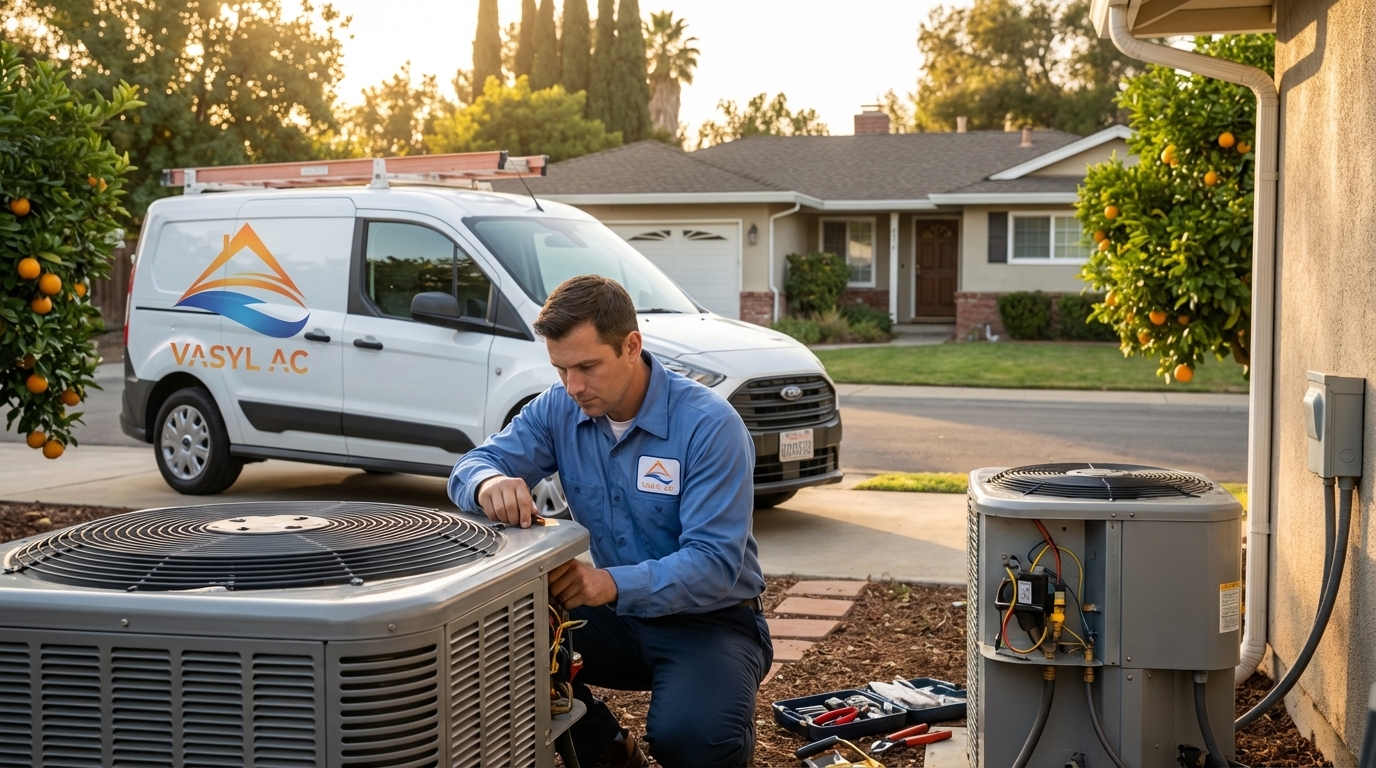
Thinking about maintenance as just an expense completely misses the point; it’s the single most effective investment for preventing a catastrophic and costly summer system failure.
A system laboring under a visible blanket of dust and cottonwood fluff is literally suffocating, drawing far more electricity with every single cycle to achieve the same cooling. This shows up directly on your utility bills, a quiet, steady drain of your money for progressively weaker performance you can feel as the rooms stay warmer longer.
That energy waste is only the beginning; the real financial damage comes from the relentless, compounding stress on the components that drive the entire system. Checking a contactor, I can see the distinct black pits and burns on the metal contact points, a clear visual sign of electrical arcing that signals imminent failure. A start capacitor that tests even 6% below its rated microfarad capacity is a ticking time bomb. It will fail when the system is under the highest load on a 100-degree afternoon. Identifying an elevated amperage draw on the compressor is another critical check; it's a visible warning on my meter's screen that tells me the unit's heart is under severe strain long before it seizes up permanently. These are not abstract issues; they are measurable signs of decay that allow me to fix a ninety-dollar part today instead of you facing a four-thousand-dollar compressor replacement tomorrow.
Beyond the pure financials, the most immediate benefit is the quality of life and comfort inside your own home. With a fully tuned system, the indoor air quality improves substantially, losing that stale, humid feeling and the faint, musty signature of a unit with dirty coils and a backed-up condensate pan. On nearly every first-time service call, I can pull out a condensate drain line so full of pink or black biological slime that you can visually see the blockage restricting water flow from several feet away. By thoroughly clearing this pathway and meticulously cleaning the evaporator coil until its aluminum fins gleam, we ensure the air your family breathes is cleaner and you regain that deep, quiet comfort that comes only from absolute system reliability.
Our Detailed AC Maintenance Process: What Does a Service Cover?
So, what separates a real diagnostic service from a cheap "tune-up"? My process begins with instrument checks, not assumptions, providing a complete picture of your system's current operational health. The first step is inspecting the thermostat for proper calibration; a slight two-degree inaccuracy will force your system into short, wasteful cycles that drive up energy bills. That simple check is a crucial first step. From there, I move to the indoor unit. I inspect the blower motor and wheel assembly, searching for the fine layer of grime that creates imbalance and noise. By cleaning this component, I not only reduce strain on the motor but also restore the powerful airflow your system was designed to deliver.
Inside the air handler, the evaporator coil gets my full attention. I inspect it with a powerful light to find the dirt and biological growth embedded deep between the aluminum fins. That is the material that creates that musty, sour taste in the air when you first turn the cooling on for the season. I then clear the condensate drain line completely using pressurized nitrogen, because a simple blockage can quickly back up and cause thousands in water damage to your ceiling. This guarantees a clear path for the water your system removes from the air.
With the indoor section cleared, I move outside to the heart of the system: the condenser unit. My first step here is not a hose, but a screwdriver to open the electrical access panel for a full inspection. I check the contactor for the tell-tale black pitting and burns on its contact points, a clear indicator of dangerous electrical arcing. The start and run capacitors are then individually tested with a dedicated meter for their microfarad (μF) rating; I compare this reading directly to the manufacturer's specification, as a deviation of even 6% means it's on the verge of failure. Afterward, I attach my gauges to check refrigerant pressures, which provides a detailed story about system performance. These readings, cross-referenced with the outdoor air temperature, tell me if there is an undetected leak. I complete the outdoor service by verifying the fan motor’s amperage draw and ensuring the blades are free of nicks or imbalances.
This is not a checklist. It’s a methodical process to prevent a mid-summer breakdown.
Common AC Nightmares We Catch During Routine Maintenance
My detailed maintenance is a forensic investigation designed to catch the subtle sounds that signal a component's impending death. A high-pitched, strained electrical buzz coming from the outdoor unit is a critical warning sign that cannot be ignored. This sound is the death cry of a failing start capacitor as its internal components vibrate and degrade under intense electrical load. Ignoring that distinct noise is a foolish gamble you will inevitably lose on the first scorching Citrus Heights day, leaving your home with no cooling and a big emergency bill.
Beyond that buzz are the mechanical death rattles that require a trained ear during any proper hvac service. I am listening specifically for a rhythmic thump-thump-thump from the outdoor unit that syncs with the fan's rotation. That noise reveals a fan blade has developed a tiny, almost invisible crack or is slightly out of balance from debris. This subtle imbalance puts enormous, destructive stress on the motor bearings with every single rotation, twenty-four hours a day. Ignoring it allows the bearings to wear down, escalating into a loud, metallic screech your neighbors can hear from their yard. Before long, the motor will seize and burn out completely. An equally damaging sound is far quieter: the steady drip… drip… drip… of water inside an attic. This indicates a clogged condensate line is overflowing its pan (a simple five-minute fix), soaking your insulation and drywall while creating the perfect, damp conditions for a serious mold problem.
Finally, there is the violent crackle of electricity arcing inside the control panel, one of the most dangerous sounds an air conditioner can make. A failing contactor, the system’s heavy-duty switch for the compressor, makes this loud snapping sound as high-voltage electricity jumps across its burnt and pitted surfaces. This is not background noise; it is a series of uncontrolled power surges directly threatening to fry the sensitive electronics and destroy your compressor, the system's irreplaceable heart, with every single startup.
Proud Official Daikin Representative in Citrus Heights
You might think all big-name air conditioners are built the same, with different logos slapped on nearly identical beige metal boxes. After fifteen years of working on every brand imaginable under the Citrus Heights sun, I can tell you that engineering philosophy makes a world of difference. That is precisely why I partnered with Daikin. They don’t build units to simply pass a minimum energy standard; they design them from the inside out with an obsessive focus on component durability and whisper-quiet operation. It represents a level of meticulous craftsmanship that other mainstream manufacturers have largely abandoned in their race for cheaper production costs.
The most significant innovation is their inverter technology, which has completely changed the standard for efficiency and comfort in residential cooling and is a core piece of their expert hvac design. Instead of the jarring, power-hungry on-off slamming of traditional single-stage compressors, Daikin systems utilize a sophisticated variable-speed motor. This advanced design allows the unit to gently ramp up or down, making continuous micro-adjustments to precisely match your home's cooling demand. Think of it like cruise control in a car maintaining a steady speed on the highway, rather than flooring the gas and then slamming the brakes. That constant, gentle modulation results in a substantial reduction in energy consumption and an almost complete elimination of uncomfortable temperature swings between cycles. By installing a Daikin, you say goodbye to those stuffy hot spots that form before the system kicks back on with a roar. The air simply feels different and tastes cleaner, completely losing that faint metallic tang of burned dust that comes from an overworked system straining under load. This is the difference between merely cooling the air and creating a truly comfortable indoor environment.
Being an official representative means I have direct factory training and a deeper understanding of these complex conditioning services. I know how to install them with precision to maximize their benefits, and I have priority access to diagnostic software and parts. This isn't about sales. It's about being an expert in a superior product I trust enough to recommend to my neighbors. That superior technology has a direct, measurable impact on the unit’s operational lifespan and reduces long-term maintenance needs. While the relentless cycle of hard starts on a conventional air conditioner puts immense mechanical strain on the compressor, Daikin’s inverter-driven units avoid this stress entirely. It’s the simple mechanical difference between an engine always running at redline and one humming along smoothly for decades.
HVAC System Upgrades & Indoor Air Quality Solutions
What happens when my diagnostic tools point to terminal failure? Regular maintenance extends life, but it cannot make parts immortal. This is the point where we stop discussing simple repairs and begin the honest conversation about an HVAC replacement, shifting the focus from patching old problems to creating a truly lasting solution for your home. With a compressor drawing dangerously high amperage or a heat exchanger showing signs of cracks, a full system upgrade becomes the only responsible financial path.
My recommendation often leads to a new Daikin system, which isn’t about swapping one metal box for another; it's a complete transformation of your home's comfort. The primary difference comes from their inverter technology, a system that modulates compressor speed instead of slamming on and off all day. Seeing the low, steady energy draw on my meter after an install confirms its superior design and translates directly to lower utility bills for you. This approach also provides incredibly consistent temperatures and removes far more humidity from the air, a huge benefit during our muggy late summer evenings when the air feels thick. Many older systems simply cannot keep up with that moisture load. With a Daikin Fit system (my preferred model for many local homes), the outdoor unit operates at a volume barely louder than a conversation, eliminating that disruptive roar right outside your window.
And true home comfort is about more than just temperature control; we must consider what’s actually floating in your air. Many homes in this area struggle with pollen, dust mites, pet dander, and volatile organic compounds (VOCs) from cleaning supplies or furniture. A standard one-inch filter from the hardware store simply cannot capture these microscopic irritants. By integrating advanced services for indoor air quality during an HVAC replacement, we can address these invisible threats head-on and make your home a healthier space. Adding a whole-home media air cleaner can capture particles five times smaller than what standard filters miss. We can also install in-duct UV light purifiers that actively neutralize bacteria and mold spores before they ever have a chance to circulate.
Why Choose Vasyl HVAC: Expert & Trusted Maintenance Services
You might think all HVAC companies in town are basically the same. They show up with similar tools and promise cool air when Citrus Heights swelters under a brutal 105°F sun. My background, however, comes from a place where precision isn't a goal but a baseline requirement for success. A place of details. Before I dedicated my life to HVAC, I spent years as a professional photographer, working with light, shadows, and composition. That career demanded an almost fanatical attention to detail, a process where a single misplaced highlight or an out-of-focus element could ruin hours of work. It taught me to see systems, not just a collection of parts but a complete composition where every piece affects the whole picture. That training is the foundation of my expert maintenance, a deep diagnostic approach that catches what a simple checklist never will.
This photographer's eye translates directly to how I inspect your air conditioner for issues others might easily ignore. A slight, almost imperceptible wobble in a blower fan is not just noise, it's a critical compositional flaw telling me the bearings are failing. I treat a slightly frayed wire not as a minor issue but as a glaring defect that signals a deeper electrical problem developing out of sight.
This is about seeing the full narrative of your system’s health, and that includes paying attention to every sensory clue. A good technician smells trouble long before he hears it, that faint, sharp, and acrid scent of ozone from an arcing contactor is a definitive signal of an electrical fire hazard in the making.
My philosophy is simple: diagnose with the eyes of a photographer and build with the hands of a craftsman. This means I never settle for a "good enough" repair when a perfect one is possible. A less careful technician might see a capacitor testing at the edge of tolerance and call it acceptable for now. I see it as a certain failure, especially since weak capacitors fail in 3 out of 10 unmaintained systems once summer heat arrives. And replacing that one inexpensive part during routine service prevents a catastrophic breakdown that will leave you stranded. From cleaning coils until they gleam like new metal to verifying the flawless performance of a high-performance Daikin rated up to 18 SEER, I leave nothing to chance. With my trusted services, you receive a level of meticulous care that goes far beyond turning a wrench. It is a commitment to ensuring your home is a sanctuary of comfort, reliability, and true peace of mind.
Frequently Asked Questions
When should I schedule AC maintenance?
Last summer, a client waited until a brutal 105°F day to call me about his dead AC. By booking your service in the spring, March or April is ideal. You avoid that panic and ensure your unit is prepared for the first real heat wave. Waiting until May or June means you'll face longer wait times and risk a system failure when you need cooling the most. You also give all that winter grime a chance to harden on the delicate fins of the coil, making it far more difficult to clean and restore proper airflow.
How often should my HVAC system be serviced?
For peak performance and the longest possible lifespan, your air conditioner needs a professional inspection once a year, always before the main cooling season begins. Systems in homes with multiple pets, smokers, or near dusty areas might benefit from a second check-in later, but that annual spring service is the non-negotiable minimum. Thinking of it like an annual car inspection keeps your system from breaking down on the road when you can least afford it.
What's included in a maintenance service visit?
My service is a complete system diagnostic, not a quick rinse with a garden hose. Checking the health of the start and run capacitors, I look for any visible bulging or readings that deviate from the manufacturer's specification. I meticulously clean both the indoor and outdoor coils, clear the condensate line with pressurized nitrogen to prevent damaging water backups; I then inspect all electrical contacts for the distinct black, pitted appearance that signals a serious fire risk. We also verify refrigerant levels to confirm the system is running at its designed capacity.
Is professional maintenance really worth the cost?
Yes, it is the best investment you can make in your home's comfort. I consistently find that weak capacitors, a relatively simple fix, are present in roughly 3 out of 10 unmaintained systems once summer heat arrives. Replacing that one inexpensive part during routine service prevents a thousand-dollar emergency repair later. A clean system, especially a modern Daikin unit rated up to 18 SEER, runs with substantially less energy waste, a savings you will see on your bill every single month.
Does my manufacturer's warranty cover maintenance?
A manufacturer's warranty is designed to cover the cost of a failed part due to a manufacturing defect, but it almost never pays for the labor to replace it. What is more critical to understand is that nearly all manufacturers can deny a warranty claim entirely if an owner cannot provide proof of regular, professional maintenance. They consider neglect the true cause of failure, so my detailed service invoice becomes your best insurance for keeping that warranty valid and enforceable.
Contact Us Today to Schedule Your AC Service
I remember an emergency call last summer on a blistering 105°F day when a family described a sharp, acrid smell from their vents, a sure sign of a fan motor overheating dangerously. That specific, preventable nightmare is exactly what my thorough maintenance service is designed to eliminate before it ever happens.
Thinking about that electrical burning smell reminds me why this work is so critical before the heat arrives. A quick phone call today schedules the exact kind of detailed inspection that prepares your system for the entire punishing season ahead. My job is to ensure every part is ready for the fight: checking the delicate electrical contacts, verifying the refrigerant charge, and clearing the lines. We find those failing capacitors (the ones that give out in 3 out of 10 unmaintained systems) and replace them proactively. By getting on my schedule now, you ensure your unit is prepared for the worst days Citrus Heights has to offer. Do not wait for a warning sign you can smell from the other room; let's get it right.
My service is about far more than just preventing dangerous odors. It is about a guarantee of reliability that you can trust when the temperature soars. A clean system, particularly a high-performance Daikin rated up to 18 SEER, operates with total integrity and without waste. This gives you a deep comfort that goes beyond just cool air. Reach out to Vasyl HVAC today to schedule your AC maintenance and secure your home's comfort for the summer.
Need AC MAINTENANCE?
Get a free quote for your ac maintenance needs in Citrus Heights.
Why Choose Vasyl AC?
✓ Licensed and insured HVAC contractor
✓ 24/7 emergency service available
✓ Free estimates on installations
✓ Experienced, certified technicians
✓ Competitive pricing and honest quotes
✓ Satisfaction guarantee on all work
Vasyl AC
Professional HVAC services you can trust. We provide expert air conditioning repair, installation, and maintenance services for residential and commercial properties.
© 2026 Vasyl AC. All rights reserved. | Licensed & Insured HVAC Contractor